If you know anything about racing, then you understand that a high-speed bypass is needed to obtain maximum horsepower. Otherwise, your engine will experience a loss of volumetric efficiency at RPM above the peak torque. At this higher RPM, the inlet valves are open for such a small amount of time that the cylinders just don’t have enough time to fill with fresh mixture.
But a high-speed bypass also benefits the mid-range performance. After all, if an engine is jetted to obtain maximum horsepower at a high RPM without a high-speed bypass, it will be lean around the peak torque RPM. Unfortunately, jetting rich enough for the best mid-range power will cause your engine to run rich and lose power at a higher RPM. And nobody wants that.
With a high-speed bypass valve, however, it’s possible to gain separate control of the mid-range and high RPM fuel rates. The main jet can be run richer for best mid-range performances, while the high-speed leans the system for best power at a high RPM. And the Kinsler K-140 high-speed bypass valve is the champ for hurtling you toward the finish line.
The Kinsler K-140 High-Speed Bypass Relief Valve Advantage
In case you’re unfamiliar, the Kinsler K-140 high-speed bypass valve is a pressure-sensitive valve in a mechanical fuel injection system that releases excess fuel back to the tank at high RPMs, leaning out the fuel mixture to match your engine’s reduced volumetric efficiency. This prevents it from getting too rich and thus optimizes power for peak performance.
Opening at a pre-determined set pressure to manage fuel flow when your engine needs less fuel per revolution at higher speeds. This is crucial for engines running on methanol in drag racing and sprint cars. The K-140 has the highest flow capacity with the lowest pressure rise of any valve on the market. For most applications, the rise is under 1-PSI, since the total bypass flow for most systems is 600 lbs/hr or less.
This high-speed bypass valve also allows for superbly smooth operation. It maintains a flow curve within 0.3 (3/10) PSI at any flow point on the opening curve. All of the moving parts are hard-coated, then micro-lapped to ensure that the pressure in the fuel system stays close to the set point on both the rising and falling engine RPM.
While it’s not uncommon to hear a buzzing sound from the hydraulic vibration of other valves, the Kinsler K-140 is much more stable. It’s the only IRL valve on the market with a unique spring arrangement designed to control that buzz. The diaphragm has a swiveling “live” center pintle that closes down on the seat, resulting in smooth operation. Plus, both the pintle and the seat are lapped for bubble tight close-off.
The hard-anodized aluminum housing components and compact design make this piece lighter (only 0.45 lbs) and easier to install in the vehicle. Components are compatible with gasoline and methanol.
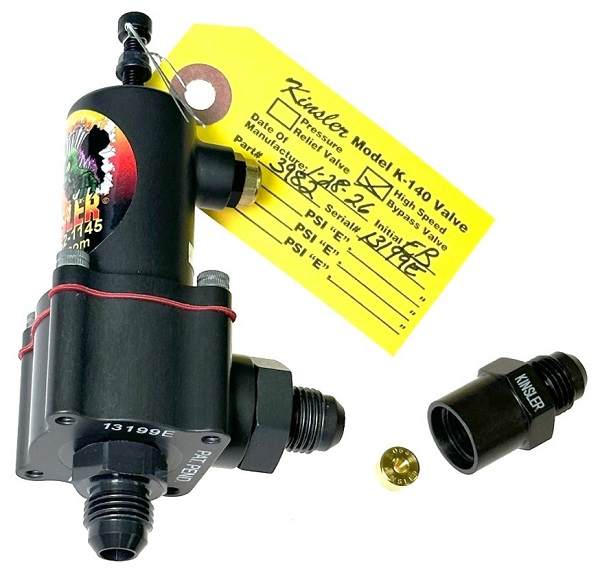
Plus, the K-140 comes complete with a 6 AN male flare inlet fitting, #3161 restrictor jet holder, and vent breather filter. Seven different spring combinations are available for a total adjustable range of 17 – 230 PSI. Custom buildup service is also available from the fuel-injection experts at Kinsler.
Tuning Tips and Basic Adjustments
It’s important to note that when properly adjusted, you, as the driver, should not feel the high-speed bypass’s engagement. If you do feel it because your engine’s power increases dramatically, then either the main jet is adjusted too rich, or the high-speed bypass is opening at too high an RPM.
Either condition will cause your engine’s output to be lower than optimum. There should be no sudden burst of power. You should feel only a steady, strong pull.
Troubleshooting
If a high-speed jet is installed on a fuel system when it is calibrated by Kinsler, the main jet and high-speed bypass setting should be very close for optimal power. However, consider the following:
1. If the fuel curve seems too rich throughout the RPM range, you should go to a leaner main jet.
2. If just the top end seems rich, go lower on the high-speed pressure setting until the high RPM mixture is correct.
A) If the system has a restrictor jet, try going .004” – .010” larger per run. (Note: The calibrated pressure settings of the high-speed valve should not require a major adjustment if the original main jet is being utilized.) Compare this with the results obtained by going lower on the valve pressure setting.
B) If the system still seems rich after step A above, lower the opening pressure of the high speed by approximately 3 PSI. The experts at Kinsler strongly recommend you reinstall the original restrictor jet before lowering the pressure setting.
C) If your engine still seems rich with the lower pressure setting, repeat step A. While this method may require several runs of your engine, it’s been found to be a safe way to tune the system while avoiding engine damage from going too lean.
3. If the system is adjusted to give a proper fuel curve, but the overall curve needs to be richened or leaned due to changes in your engine displacement, air density, weather, altitude, etc., adjust the high-speed pressure for each main jet step you adjust.
4. And finally, always tune your engine for best performance, not just what appears to be good plug readings.
How do I set the K-140 High Speed Bypass Valve?
The Kinsler K-140 High Speed Bypass Valve has many features and the video below explains the function, servicing, and how to set the valve.
The Function of the Restrictor Jet
While the pressure setting of the high-speed bypass valve is used to control the RPM at which it opens, the restrictor jet limits the flow through it after it opens. The smaller the jet, the less fuel that can flow through the high-speed bypass valve and back to the tank. The end product? A richer system at higher RPM levels.
The use of a restrictor jet assures that the high speed does not dump off too much fuel at high RPM part throttle. If you own a high-speed bypass valve that doesn’t have a provision for a restrictor jet, simply use a jet can after the valve by removing the poppet and stretching the spring out to hold the jet in place. Be sure that the jet can has a jet sealing o-ring.
Turn to the Experts in Fuel-Injection
At Kinsler, we’re 100% versed in fuel-injection parts and equipment for optimal racing because it’s all we do. And we offer products that nobody else does.
Plus, once you purchase any of our top-of-the-line products, our service team is ready to help you with any questions/concerns/needs you may have.
So if you’re ready to see how the Kinsler K-140 high-speed bypass valve can seriously amp up your engine’s performance, contact us today.
People Also Ask
What kind of K-140 High Speed Bypass Valve models does Kinsler have and what are their PSI ranges?
We offer seven different models of the K-140 High Speed Bypass Valve with varying PSI ranges that include:
- #3977 High Speed Bypass Valve, K-140, 17 – 37 PSI Range
- #3978 High Speed Bypass Valve, K-140, 26 – 51 PSI Range
- #3979 High Speed Bypass Valve, K-140, 35 – 80 PSI Range
- #3980 High Speed Bypass Valve, K-140, 48 -110 PSI Range
- #3981 High Speed Bypass Valve, K-140, 65 -130 PSI Range
- #3982 High Speed Bypass Valve, K-140, 85 -170 PSI Range
- #3983 High Speed Bypass Valve, K-140, 88 – 230 PSI Range
- #12091 Kinsler K-140 Replacement Diaphragm